Masada
One of the Great Tragedies of Jewish History

In 74 CE, the Romans laid siege to the last enclave of Jews left in their land. God had promised them this land 2,000 years earlier and given it to them 1,500 years earlier.1 And now, their capital, the city of David, Jerusalem, lay in ruins.
These people, 967 in all, including men, women, and children, took refuge in Masada. Masada was a fortress built atop a single mountain rising up a quarter mile from the desert floor. Built approximately 150 years earlier, and improved by Herod the Great 100 years before, the fortress was thought to be impregnable. But alas, the Romans came along with their dogged determination to conquer. Furthermore, the Romans had the might, the resources, and the engineering skills to be able to overtake Masada.
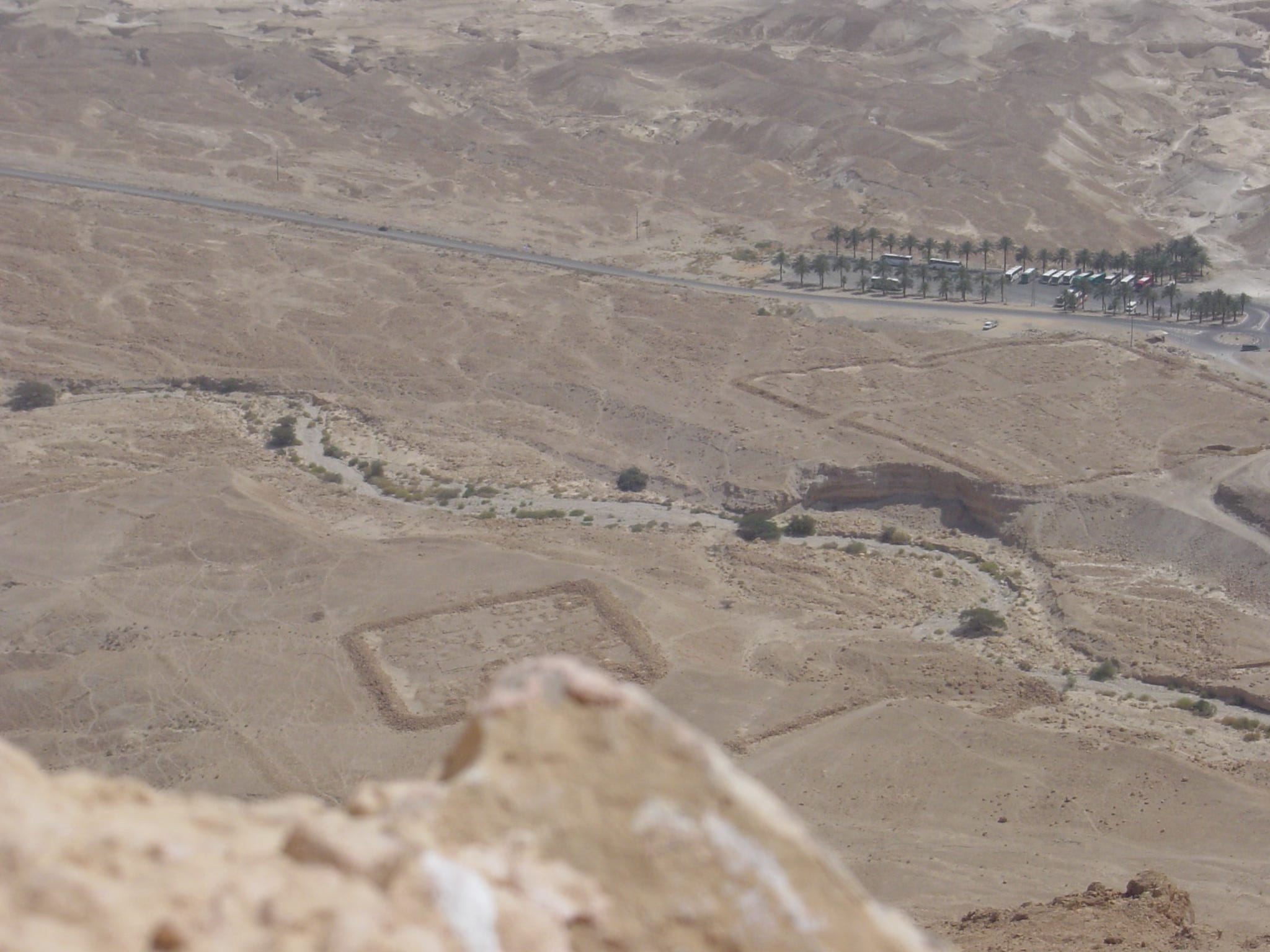
Looking down from atop Masada. The two rectangles on the desert floor are the barriers the Romans constructed around two of their encampments.
The first thing the Romans did was to build a wall around the base of the mountain to prevent any Jew from escaping. Then the Roman General, Silva, began to build a ramp all the way to the top of the mountain. How good was Roman civil engineering? Well, they did not construct it for durability. They only needed it briefly. They had no modern power equipment, and the conditions were horrible. They were in the desert. Nonetheless, the ramp remains still to this day.
Why did they need a ramp? They needed it because there were only two foot-trails leading up to the top of the mountain, and they were precarious. The historian, Josephus, recorded that one of the trails was named, “the Serpent,” because it curved back and forth in its ascent up the mountain.2 Furthermore, it was so narrow that a column of men only one person wide could traverse it. Thus, there was no way for the Roman troops to mount an assault on the fortress at the top of the plateau. Hence, they built a ramp which was accessible to not only their troops but also their “war machines.”
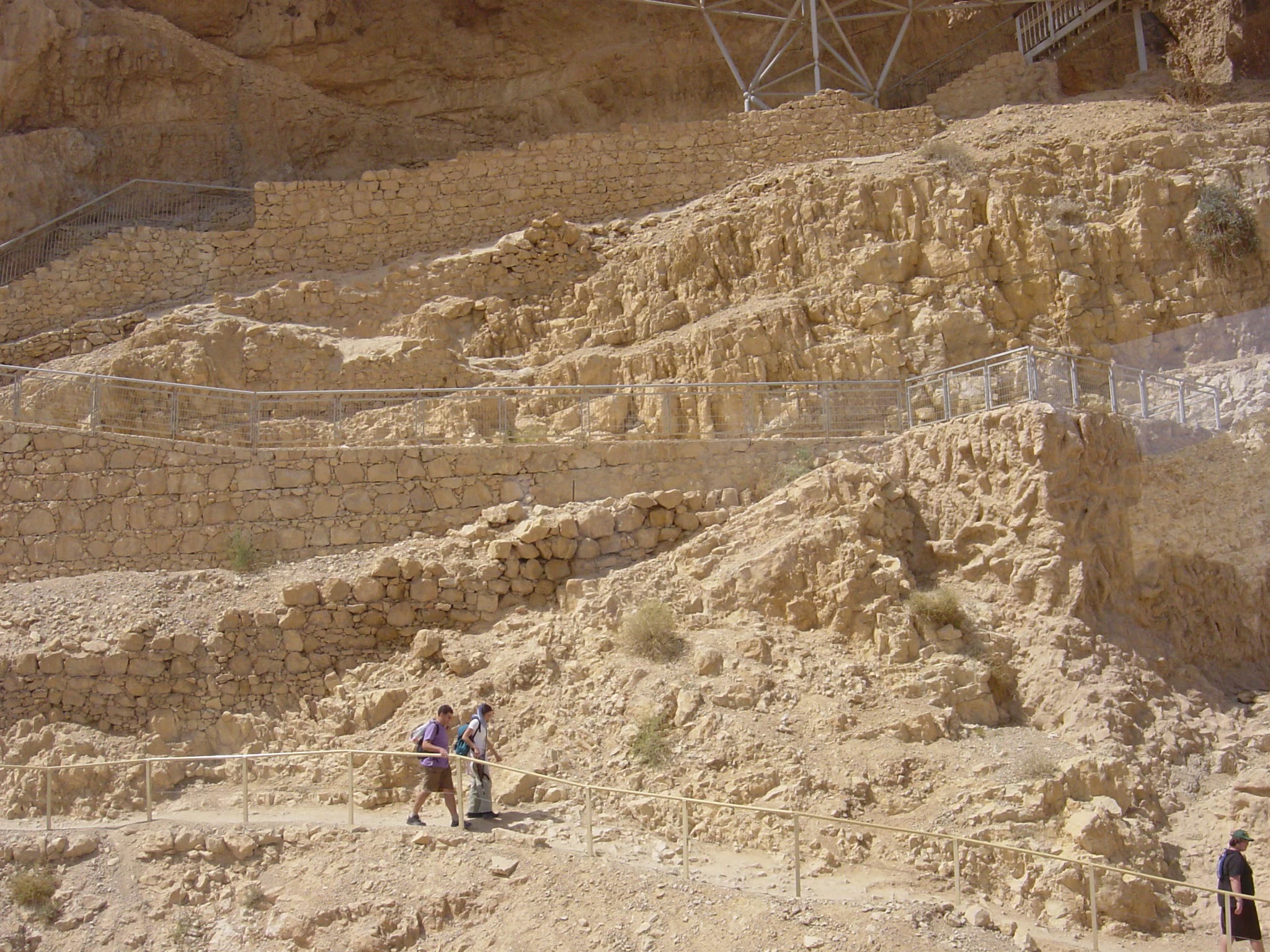
The ramp today. (photos taken by the author)
The fortress consisted of stone walls that were 18 feet high and 12 feet wide.3 Once the Romans constructed their ramp, this seemingly formidable wall succumbed to a Roman battering ram.4 The Jews scrambled to repair the wall using wood beams and earth. The battering ram proved futile against the Jewish repair as the new section of wall actually became stronger when it was hit by the ram as the blows compacted the soil. Therefore, Silva decided to change tactics and burn the wall down by catching the wood on fire.
The moment of truth came. The Roman soldiers were atop the ramp, hiding behind their war machines and throwing torches against the wood beams. Success appeared in their grasp as the wall ignited. But then this happened:5
Now at the very beginning of the fire, a north wind that then blew proved terrible to the Romans; for by bringing the flame downward, it drove it upon them, and they were almost in despair of success, as fearing their machines would be burnt; but after this, on a sudden the wind changed into the south, as if it were done by divine Providence, and blew strongly the contrary way, and carried the flame, and drove it against the wall, which was now on fire through its entire thickness.
There was now a gaping hole in the wall. But apparently it was late in the day, and Silva ordered the men to return to their camp at the base of the mountain and prepare to attack in the morning. What happened next is legendary.
The leader of the Jews was a man named Eleazar. His speeches and plan are presented in Josephus’ Wars. It is beyond the scope of this essay to go into detail about this event, but it was absolutely heart-wrenching. I encourage you to read Josephus’ account, which is available for free on the internet. But essentially, much like Jim Jones of Jonestown in Guyana, he called for the suicide of everyone. In the end, 960 people perished that night.
Unlike Jones, Eleazar was not mentally disturbed, but rather, stone-cold sober. This was arguably their best option. For, the Romans were barbaric animals. Time and history have given us the misperception that they were civilized. But Eleazar knew better. He knew what happened four years earlier, when Jerusalem fell. Although the soldiers killed a tremendous amount of Jews in Jerusalem, they could not kill them all. The survivors were to be brought to Rome and sold as slaves. But many did not make it there. Here is what happened to them:6
But as for Titus, he marched from that Cesarea which lay by the seaside [Cesarea Maratima,] and came to that which is named Cesarea Philippi, and stayed there a considerable time, and exhibited all sorts of shows there; and here a great number of captives were destroyed, some being thrown to wild beasts, and others in multitudes forced to kill one another, as if they were enemies.
After all, what better way to celebrate your victory than holding shows in which your captives are murdered in the most bloody way imaginable. Again, we have been subjected to propaganda espousing the greatness of Rome. They were the victors, and they got to write the history books. So, the accounts we have present them in the best possible light. We have been so impacted by the Romans that in the first half of the 20th century, public schools taught Latin, a dead language. Indeed, three of our months are named for them, June after the Roman goddess Juno, July for Julius Caesar, and August for Augustus Caesar. But the truth is that the Romans were monsters.
Eleazar knew that if they attempted to surrender at dawn, the women would have been raped, the children would have been sold into slavery, and the men would have been tortured and killed.7 Hence, his decision was accepted and carried out.
The question is, why did the Romans care? These people posed no threat to them. Judea was obliterated. These families had no intention of being a thorn in the side of Rome, let alone regrouping and taking them on. They simply wanted to live in their homeland and worship God. So, why on earth would the Romans expend so much time and effort building this ramp in the desert to wipe out the last remaining vestige of Jewish presence in Judea? Perhaps the answer is that they did this to bolster their reputation, lest any other occupied people seek to rebel. Or, perhaps the answer is simply that the Roman Empire was run by a cabal of evil men who were drunk with power.
Astonishingly, nothing has changed in regard to the way the world views the Jews. The current rallying cry of anti-Semites around the world, “from the river to the sea,” means that they want to recreate Rome’s horrific war against the Jews.
Gen. 12:1-7; Josh. 1:1-6; Josh. 1-24.
Josephus Flavius, Wars, 7:8:3 (280-284.) from: The Works of Josephus, Complete and Unabridged, New Updated Edition, trans. William Whiston, A.M. (Peabody, MA: Hendrickson Publishers, Inc., 2009) 764. [This reference of book 7, chapter 8, paragraph 3 (numbers 280 through 284) is per the Whiston numbering system in which the numbers given in parentheses correspond to the ones used in the Greek text.]
Josephus, Wars 7:8:3 (286.)
Josephus, Wars 7:8:5 (310.)
Josephus, Wars 7:8:5 (317-318.)
Josephus, Wars 7:2:1 (23-24.)
Josephus, Wars 7:8:6 (333-334;) 7:8:7 (372-374.)
One of the things I appreciated most about this piece is that it encourages readers to look beyond familiar historical narratives and think critically about the human consequences of conflict. Regardless of one's perspective on history, stories like Masada invite reflection on resilience, leadership, and the tragic cost of war. Thanks for putting together such a thought-provoking article.
I appreciate how this article brings attention to a chapter of history that many people know very little about. Whether someone agrees with every interpretation or not, it's an important reminder of the immense human cost of war.